
Should HDPE injection molding choose new materials or recycled materials?
author: Universe plastic
2024-06-18
What is HDPE material
HDPE refers to high-density polyethylene material, a thermoplastic polymer polymerized from ethylene monomer. HDPE has high strength, low density and excellent chemical resistance, and is widely used in injection molding manufacturing of plastic parts in various fields.
Many customers don't know whether to choose new materials or recycled materials when injection molding HDPE products. This article will help you understand the specific performance differences between these two materials and know how to choose.

HDPE material category
Ordinary HDPE: The molecular weight is generally between 200,000 and 500,000, with wear resistance, impact resistance, chemical resistance and high flexibility.
High molecular weight HDPE: with a molecular weight between 500,000 and 1,000,000, it has high strength, hardness, wear resistance, and impact resistance.
Ultra-high molecular weight HDPE: The molecular weight usually exceeds 1,000,000, even up to millions, and has extremely high wear resistance, impact resistance and chemical corrosion resistance.
HDPE material properties
1. High strength and stiffness
HDPE has high tensile strength and modulus, and has good structural properties in various engineering applications.
2. Excellent chemical resistance
It has good resistance to many chemicals, solvents, greases and acids and alkalis, and can be used in harsh environments for a long time without being chemically attacked.
3. Good wear resistance and abrasion resistance
HDPE exhibits excellent wear resistance, especially ultra-high molecular weight HDPE (UHMWPE), which can be used to manufacture wear-resistant parts such as bearings, sliding elements and guide rails.
4. Good impact resistance
HDPE still maintains good toughness and impact resistance at low temperatures and is not easily broken or broken.
5. Excellent anti-aging properties
HDPE has good oxidation resistance and UV resistance, and can be used in outdoor environments for a long time without aging or deterioration.
6. Good processing performance
HDPE has good melt fluidity and processing adaptability, and can be used to manufacture products of various shapes and sizes through blow molding, injection molding, extrusion and other processing processes.
Applications of HDPE materials
1. Engineering pipe fittings: water supply, drainage, gas and other transportation pipes, underground drainage pipes, electrical insulation materials, waterproof membranes, roof waterproof materials.
2. Daily items: plastic bottles, containers, jars, food packaging bags, shopping bags, trash cans and trash cans, etc.
3. Automobile parts: fuel tanks, coolant tanks, air filters, body parts, etc.
4. Chemical application: chemical storage containers, chemical pipelines, etc.
5. Medical equipment: operating room supplies, medical devices and reagent bottles.

Parameter comparison between new HDPE and recycled HDPE
|
Property |
New HDPE Material |
Recycled HDPE Material |
|
density |
0.941-0.965g/cm² |
>0.940g/cm² |
|
Mechanical behavior |
excellent |
deviation |
|
chemical resistance |
High resistance |
will reduce |
|
Environmental friendly |
no |
yes |

The main differences between HDPE new materials and recycled materials
1. Physical properties
New material: It has higher density and more uniform molecular structure, so it has better mechanical strength, wear resistance and impact resistance.
Recycled materials: Affected by material fatigue and degradation during the recycling process, the physical properties are generally slightly lower than those of new materials.
2. Chemical properties
New material: It has good chemical resistance and can resist the erosion of various chemicals and the penetration of solvents.
Recycled Materials: Chemical properties may be affected by residual impurities or aging effects from the recycling process, and chemical resistance may be reduced.
Conclusion
In summary, the choice of new HDPE or recycled HDPE during injection molding should be considered based on specific application requirements and environmental impact. New HDPE usually has superior performance and durability, while recycled HDPE helps reduce resource consumption and environmental burden.
Should PA injection molding choose new materials or recycled materials?
Should AS injection molding choose new materials or recycled materials?
Related Article

AS new materials have higher performance and stability and are suitable for applications with higher performance requirements, while recycled AS materials are suitable for applications with lower performance requirements due to their environmental protection and cost advantages.
Should AS injection molding choose new materials or recycled materials?

New materials and recycled materials each have their own advantages and disadvantages. The choice of which material to use mainly depends on the product's performance requirements, cost considerations and environmental factors.
How to choose new materials and recycled materials for injection molding PS

For application scenarios with high performance requirements, new materials are still the first choice; while in applications that do not require high performance and pay attention to cost and environmental protection, recycled materials have significant advantages.
How to choose new and recycled PVC materials for injection molding

New ABS materials are suitable for demanding applications, while recycled ABS materials have advantages in low-cost and environmentally friendly applications.
How to choose ABS new material or recycled material for injection molding
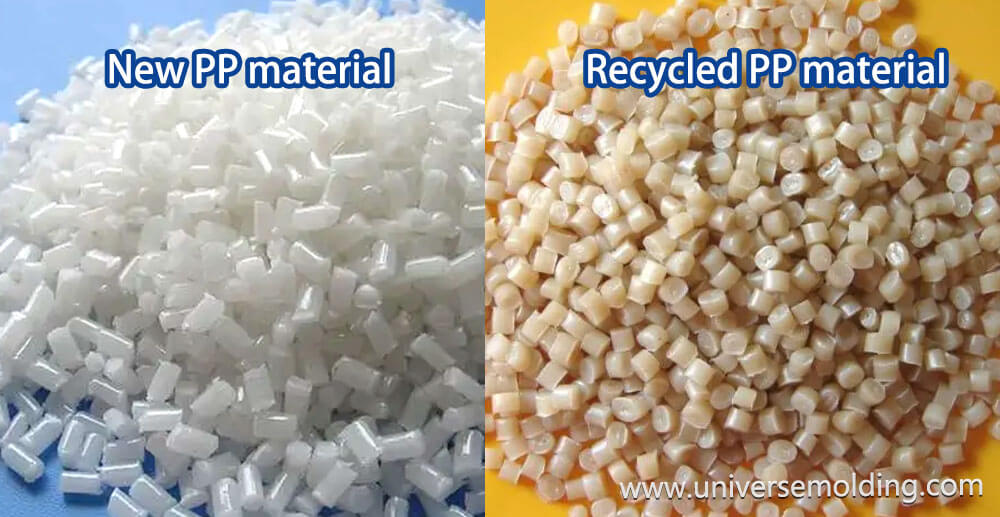
The new PP material has clear advantages in performance and is suitable for injection molding applications that require high performance, reliability and aesthetics.
How to choose new and recycled materials for PP injection molding
Polyoxymethylene (POM), is known as acetal, POM is a versatile engineering plastic which has mechanical properties
New POM vs Recycled POM: How to Select the Right material ?


Get a free online quote today!