
8 common ways to make plastic products
author: Universe plastic
2024-03-15
Since humans discovered plastic, there have been more and more plastic products in production and life, and most metal objects have been replaced by different plastic materials.
How are so many plastic products mass-produced?
This article will give you a detailed introduction to several common manufacturing methods of plastic products in today's industrial production.
1. Injection molding
Injection molding uses an injection molding machine and a plastic mold to melt, mold, and cool thermoplastic or thermosetting materials to create plastic products of various shapes.
It is the most widely used plastic manufacturing technology and is used to produce small packaging boxes, daily necessities, special-shaped parts, etc.
The quality of injection molded products has the same color, size, structure, appearance, marking and other excellent qualities.
Injection molding requires the manufacture of customized molds.
Injection molding requires the manufacture of injection molds, which have high mold costs, but injection molding production costs are low, and batch production of products is efficient and cost-effective.

2. Blow molding
Blow molding is to put the tubular plastic parison into a split mold while it is hot. After the mold is closed, high-pressure air is injected into the parison to expand the plastic parison and adhere to the inner wall of the mold. After cooling, the parison is demoulded to obtain Various hollow plastic products.
Blow molding is commonly used to produce various types of hollow packaging containers, films, sheets, etc.
The quality of blow molded products depends on balanced thickness, uniform weight, consistent color, and smooth and complete surface.

3. Blister molding

The main principle of blister molding is to heat and soften a flat hard plastic sheet, then use vacuum to adsorb it to the surface of the mold, and then cool it to form.
It is widely used in the production of basins, plates and bowls, as well as in plastic packaging, lighting, advertising, decoration and other industries.
The use of the blister molding process requires consideration that the product shape must be suitable, the mold must be able to fasten the product, the thickness must be balanced, and the surface must be smooth and flawless.
4. Extrusion molding
Extrusion molding mainly uses an extruder to extrude molten plastic through the gap of the mold to form a profile similar to the shape of the die mouth.
After extrusion, it needs to be rapidly cooled and solidified. Extrusion molding is mostly used to produce plates, pipes, rods, wires, special profiles, etc.

5. Die casting molding
Die-casting is to put heated plastic material into the mold cavity, fasten the two templates through the pressure of the die-casting machine, and take out the die-cast finished product after cooling.
By removing the corners, you get a plastic product. It is suitable for the molding of thermosetting plastics and composite materials, and can produce larger and thicker products.
It is used by Universe Plastic Factory to manufacture plastic floors, plastic signs and other products.
6. Rotational molding
Rotational molding is to pour materials such as plastic powder particles into a mold.
The mold is then continuously rotated and heated so that the plastic powder melts and adheres to the inner wall of the mold, and is formed after cooling.
Suitable for the production of large hollow products, the mold cost is low and suitable for small batch production, such as large water storage tanks, plastic shells, and plastic ship hulls.
7. Thermoforming
Thermoforming is to heat and soften the plastic sheet, lay it on the surface of the mold, use air pressure to attach it to the mold cavity, and finally cool it to shape.
Thermoforming has low production difficulty, low mold cost, and short production cycle.
It is suitable for small batch manufacturing and is widely used in DIY and product research and development.
8. 3D printing
Thermoforming is created by creating a 3D digital image of a plastic product, which is then manufactured by a 3D printing device using the corresponding plastic material through an additive process.
The manufacturing process does not waste material. 3D printing has low production precision, no mold cost, and fast production cycle.
It is suitable for small batch manufacturing and is widely used in DIY and product research and development.
Plastic Prototyping: 3D Printing
Injection molding experience sharing: How to buy injection molds
Related Article

When purchasing injection molds, issues to consider include: Does the mold have good mass production properties? What is the mold life? What is the mold production efficiency? These are all things you must know clearly.
Injection molding experience sharing: How to buy injection molds

Different brands of ABS produced in various countries have large color differences. Even for ABS materials of the same brand, color differences may exist in different batches. Of course, color differences will also occur after using masterbatch coloring.
Injection molding problem: abnormal color of plastic

mold design and mold processing. In addition, the defects of some products themselves will also affect the mold accuracy.
How to improve mold accuracy?
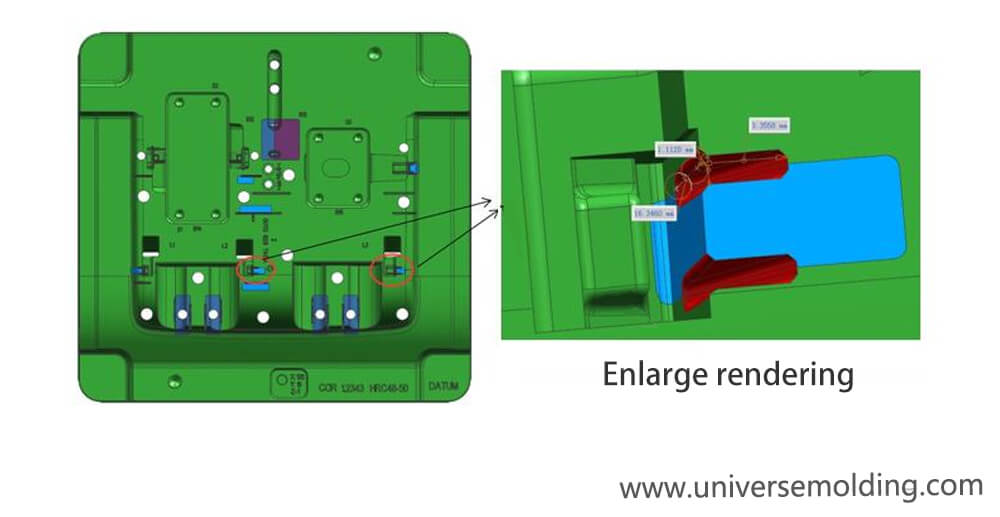
At Universe Plastic Factory, professional product design change information is as follows
Injection molding product design change processing

Delamination and peeling of plastic can seriously reduce the appearance and performance of the product, resulting in substandard products.
Injection molding problem: plastic delamination and peeling

This type of sign strictly adheres to ADA requirements and is a sign with raised dots that can be read by touch.
American ADA braille signs

Ensure that plastic mold parts can be ejected and reset smoothly during the injection molding process to ensure smooth demoulding of the product and normal use of the mold.
Injection mold processing: mold parts
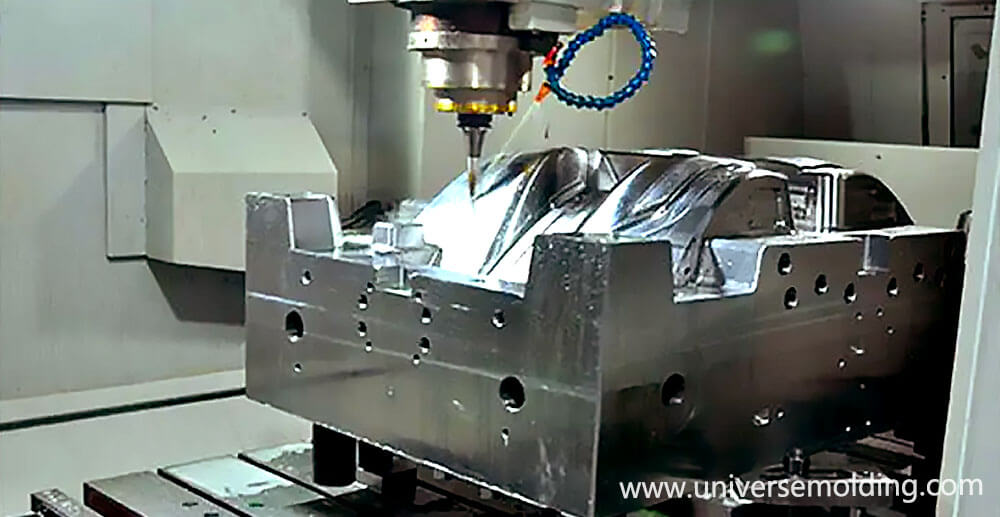
There are many factors that affect the price of plastic molds, including material cost, manufacturing process, technical requirements, degree of customization, quality assurance, market demand, production cycle, technology updates and after-sales service, etc.
Injection mold processing: mold cost control
Get a free online quote today!